
About me
How I came to edit seminal books of current and future leaders
Who I am
I started in electronic & printed media very early, before I earned my twin master’s degrees in writing. Later I was a copywriter and strategist, a trainer and coach, an e-learning pioneer, and a visibility expert in public service reform. Long active in book publishing, I still work at the intersection of analog, digital, and creative realms.
Who I serve
Busy business or tech icons keen to capture their unique legacy. Academic or other experts unwinding their arcane knowledge. First-time authors eager to share a tough personal history in a memoir. I’m accepting high-stakes manuscripts of stories that matter.
Fruits of a long career
Check out my sectors and niches

AI & Automation

Banking & FinTech

Culture & Entertainment

Data Management

Education

Food & Beverages

Health & Wellness

Information Technology

Logistics & Mobility

Media & Publishing

Not-for-Profit & Public Service

Public Sector & International Aid
Some of my past clients






One more thing
My secret power
I’m an early adopter of digital. I bought my first PC in 1986; I use all three major operating systems and the three dominant word processing platforms; I track innovation in a range of fields. I link digital pioneers and the AI-driven present. I see future trends most people miss. That too is a form of creativity. A futurist by nature, I also work hard to be an informed one. From that vantage point, I offer authors a future-proof perspective that traditional editors cannot match.
It’s a verifiable claim. Elon University’s Imagining the Digital Future Center periodically conducts surveys of experts. Tech leaders, visionaries, professors, lawmakers, and other important stakeholders—with several Internet Hall of Fame members among them—offer their opinions and predictions. From those unique inputs, a team of researchers compiles detailed reports on the most pertinent questions of our time. I contribute to that influential research; my essays are featured regularly among those of Tech’s elite.
Editing comes close to mind reading
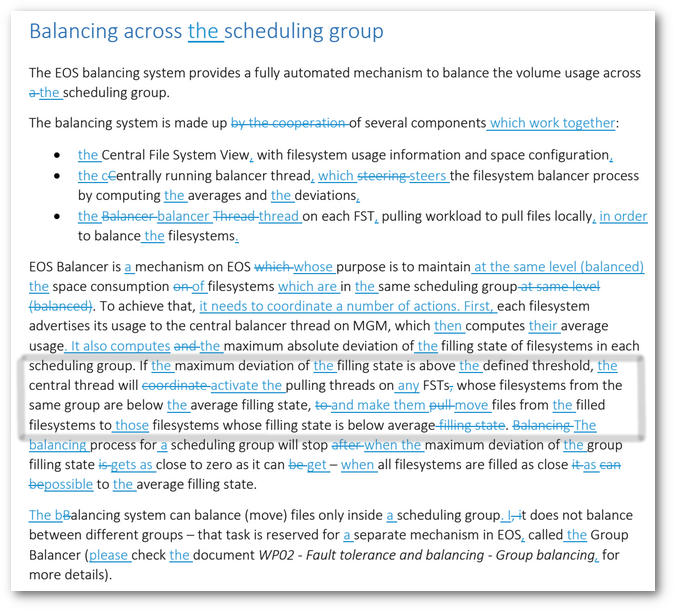
Here’s a “Before …”
“If maximum deviation of filling state is above defined threshold central thread will coordinate pulling threads on FSTs whose filesystems from the same group are below average filling state to pull files from filled filesystems to filesystems whose filling state is below average filling state.”
And “… After”
“If the maximum deviation of the filling state is above the defined threshold, the central thread will activate the pulling threads on any FSTs whose filesystems from the same group are below the average filling state and make them move files from the filled filesystems to those filesystems whose state is below average.” (Excerpt from CERN’s EOS Data Management System user manual I helped edit in 2019.)